Monday, 11 March 2013

Evaluation part 5


My magazine is mainly targeted at teenage boys but a fair amount of teenage girls would also be interested in it. I am targeting at this at this audience because it is primarily young people who listen to this sort of music. There are also a larger number of boys who listen to this music than there is girls.

The class would be lower to lower middle class because anyone of a higher class would view themselves as more cultured and not enjoy listening to the music included in the magazine. These are the demographics for my magazine.

The main psychographic would obviously be anybody who listened to the hardcore or metal genre. Not many other psychographics would influence the people who read the magazine.

A lot of the advertising would be for music or other things that young people would be interested in like video games and fast food. There would be no point in advertising jewellery or a new car as my target demographic would not be interested in it.


My magazine would attract the audience by featuring articles from the bands that they are interested in. The bright colours of the masthead and the featured writing would make people notice the magazine from a distance and maybe make them want to take a closer look.

The offers inside the magazine such as signed posters and some money off next weeks issue may make people inclined to buy it or even subscribe. Because the magazine was written by someone who is the age of the target audience, the magazines features language which isn’t too complicated for young people and if it features slang then the demographic will be familiar with it.

Evaluation part 4


My product represents the particular social group of people who like metal and hardcore by appealing to them with the bands included inside the magazine. The pictures area also all of young people, who would be the ones reading the magazine. I have implied that they have the qualities of having a lot of fun and enjoying life as much as they can.

A lot of youths are stereotyped for violence in the mainstream media and this is something I have not included in my magazine as it helps to enforce a positive view of young people. I have neither reinforced or challenged stereotypes but instead tried to present everyone in the magazine as just normal people.

My pictures are all light-hearted compared to the often serious poses in most magazines. It creates an atmosphere of light-heartedness and everyone being friendly towards each other.

People often associate listeners of metal with dark clothing and black hair but the picture on my front cover features a boy in a bright orange suit. This is going against the stereotype for that particular area.


I think my magazine would be published by Bauer as they publish a lot of music magazines but none of them have such a heavy focus on the hardcore genre. I believe that they would want to publish it because it would offer a broader audience for their company and get them a lot more sales.

The new variety they would gain from it would be beneficial to them and would help with the selling of my magazine. Publishing independently would allow for a lot more creative output but it would also be a lot harder to advertise the magazine and sell it. It is a very good advantage to have a publishing company behind the magazine. The only disadvantage would be if they took a lot of the creativity from the makers of the magazine, but I believe with a music magazine such as this that not a lot would need to be edited and thus a publisher is the best way.

Evaluation part 3


The magazine front cover looks like a conventional magazine cover. I added the masthead at the top just like a normal magazine. It covers the top of the page and isn’t too big t or too small. I also have a banner at the top advertising something that is included inside the magazine.

The picture takes up most of the page, leaving no gaps. This is sticking to the normal conventions along with making the picture a mid shot. I kept to 3 colours in the front cover which were green, blue and white. These colours went well together and didn’t clash.

Evaluation part 2


My contents page looks like a typical music magazine contents page. It includes pictures like conventional magazines in order to show people what they will be seeing inside the magazine. Pictures are important as if a contents page only included words then it would be a lot more boring to look at.

It includes headings about each section of the magazine, grouping the pages into a section so that it is easier to navigate. The headings had to be lined up which was difficult or it wouldn’t have looked right.

It is important to stick to 2 or 3 colours throughout the whole page, in this case I stuck to green, purple and white. I picked these because I think they go well together and make the page look presentable.

Evaluation part 1


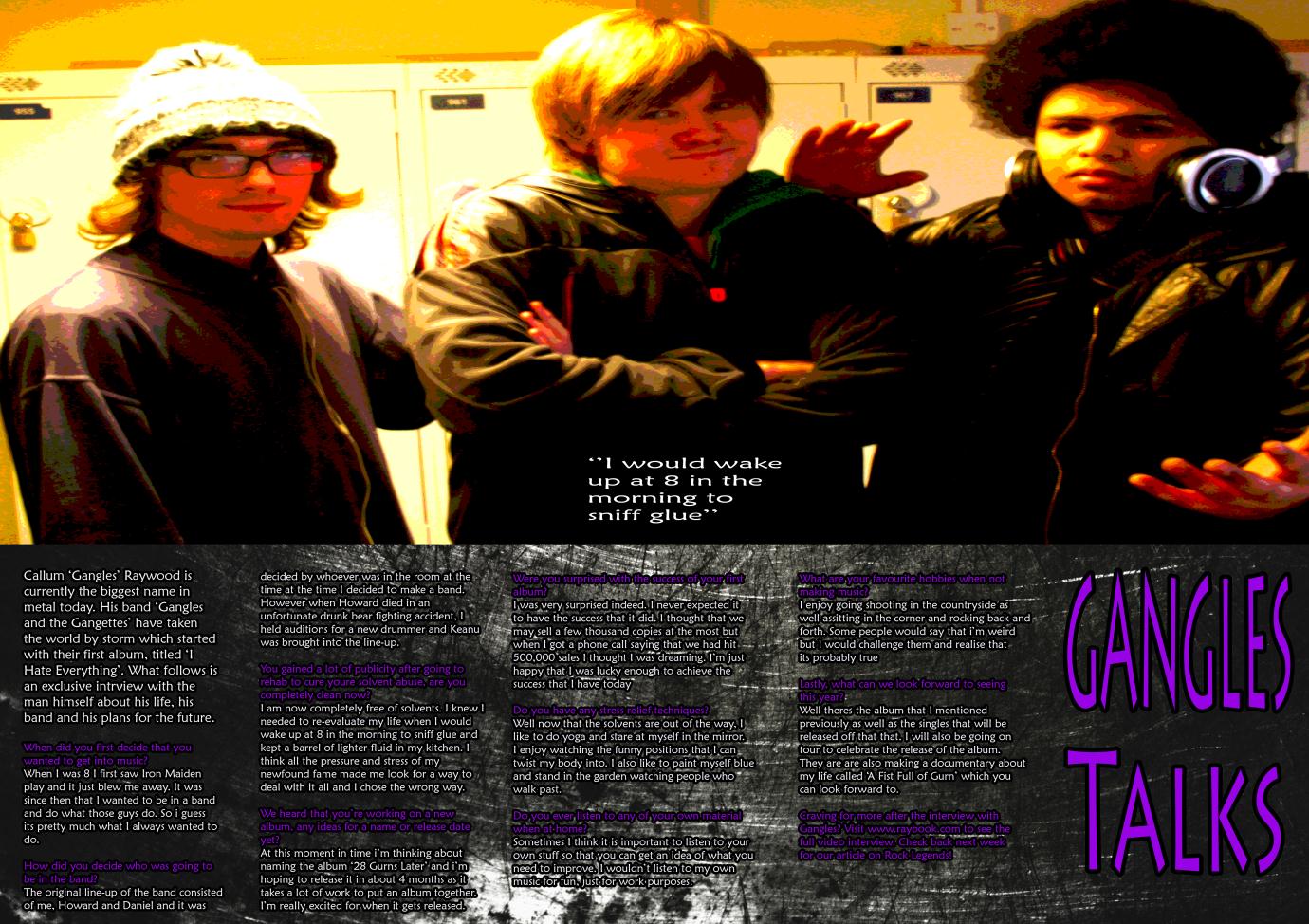
The conventions that I have used in the feature article share some things in common with normal magazines. I added the title at the right side of the page instead of the usual left side. I believe that this separates it from normal magazines and gives it a bit of difference. I kept in with the usual styles of magazines however by making it the usual size.

I kept the text in columns like magazines usually do and separated the interviewer questions by putting them in a different colour. I put the pull quote inside the picture as opposed to the usual in the middle of the text.

The picture is at the top of my page like it is in many magazines. I think my feature article mainly sticks to the codes and conventions presented in normal magazines. I produced a metal/hardcore magazine and the dark colours keep in with the usual style of that

Tuesday, 11 December 2012

Magazine case study


There are many things that you can say about a magazine and its history. How it has developed, how it uses technology, the relation to the audience, the advertisers and the funding. The music magazine that I am analysing is called Kerrang.

History

Kerrang was first published on the 6th June 1981. At first it focused on the new British Heavy Metal movement but later broadened out to other types of metal and rock. It rose in popularity in the early 2000’s and became a best selling music magazine.

The rights were sold in 2009 to the Bauer Media Group who overlook the publication of the magazine.

Content

Kerrang features articles about bands and events, usually in the metal or rock genre. There are a few articles about bands in each issue, upcoming gigs and news about what is happening. The feature article is always shown on the front of the magazine and will be the most recognisable from far away. The feature articles are usually a double page spread but sometimes they can span over 4 pages.

There are also other smaller articles included in the magazine; some of these will be advertised on the cover, but not all due to not enough space. Other sections include letters sent in by readers, gig reviews and what is featured next week.

Demographic

The magazine is mainly marketed towards teenagers of both genders. The market is more niche than other music magazines due to the type of music inside isn’t listened to by the majority of people. The writing style fits in with the demographic of the magazine.

Friday, 16 November 2012

Target Audience mood board

This is my mood board for my target audience. There is a picture of gigs because most of the people who read about metal and rock in a magazine also enjoy seeing it live. Download festival is on there because it is one of the main festivals that people go to.
Because the target audience is lower middle class teenagers and below, there is a picture of what the average teenager would look like. There are also some pictures of different bands playing who would most likely be in the magazine.